Useful scheduling tools before you ever need another piece of software
Start with a workbook built for your actual scheduling problem, pressure-test the rules behind your weekly plan, or learn where spreadsheet scheduling usually becomes difficult. These resources are designed to be useful even if you never create a RoleSchedule account.
Use a spreadsheet designed around the decision you need to make
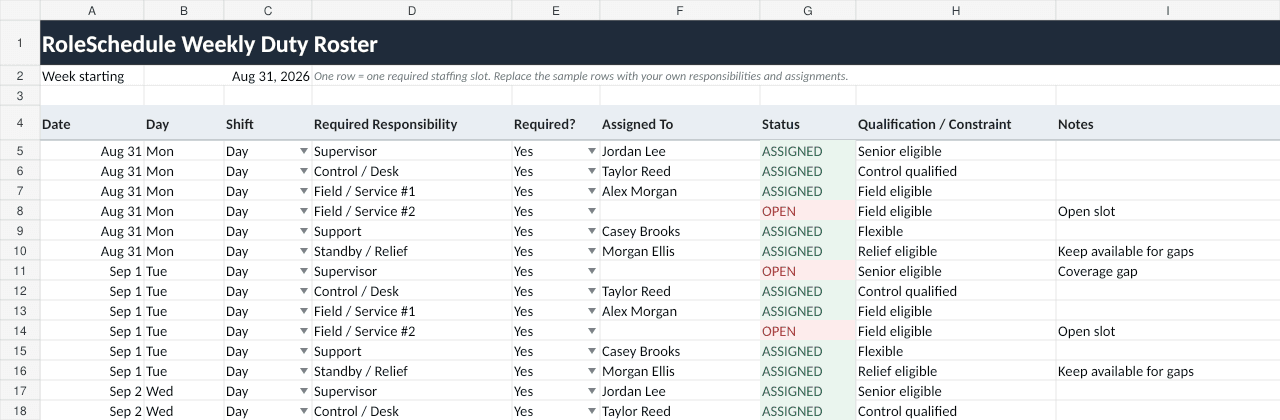
The new template library separates six different jobs: duty coverage, weekly employee hours, continuous 24/7 staffing, reusable shift planning, military duty rosters, and security post coverage. That keeps each workbook useful instead of forcing every scheduler into one generic calendar.
Templates, checklists, and guides for different scheduling questions
Calculate staffing, FTE, coverage, work/rest feasibility, overtime pressure, rest windows, and common rotating shift patterns.
Choose a purpose-built workbook for duty rosters, weekly employee schedules, 24/7 staffing, shifts, military duties, or security posts.
Learn why enough people on a shift does not always mean every required responsibility is covered.
See how coverage, eligibility, absences, overlap rules, rest windows, and human exceptions fit into constraint-based auto scheduling.
A practical pre-build checklist for requirements, qualifications, absences, standby, work limits, and publishing.
Use a spreadsheet well, recognize where it starts breaking down, and decide when purpose-built scheduling software is justified.
The spreadsheet is not usually the problem. The growing number of rules around it is.
If every assignment requires checking a qualification list, an absence tracker, work limits, team boundaries, and yesterday's version of the schedule, the manual process has become the system. That is the point RoleSchedule is designed for.
See the scheduling workflow →